
10 Hidden Gems in Ireland You Probably Don’t Know About

Some of my favourite hidden gems in Ireland are the places we almost drove right past! We’ve road-tripped around Ireland twice now, and while the big-name sights are absolutely worth seeing, I love finding the weird little stops that don’t show up on every itinerary. Sometimes we planned them, but more often than not, we randomly spotted it on Google Maps or a signpost and decided to check it out.
That’s what this guide is about. These are ten hidden gems in Ireland we found while road-tripping around the island, from ancient ruins and tiny roadside stops to places I still can’t believe aren’t more popular.
If you’re looking for the big attractions too, I have a separate guide to the must-see places in Ireland. But if you want to take a few detours, keep reading.
Ireland Hidden Gems Map
To make things easy, I’ve put all ten hidden gems on the map below so you can see where they are and which ones might fit into your Irish road trip.

1. Moore Hall in County Mayo
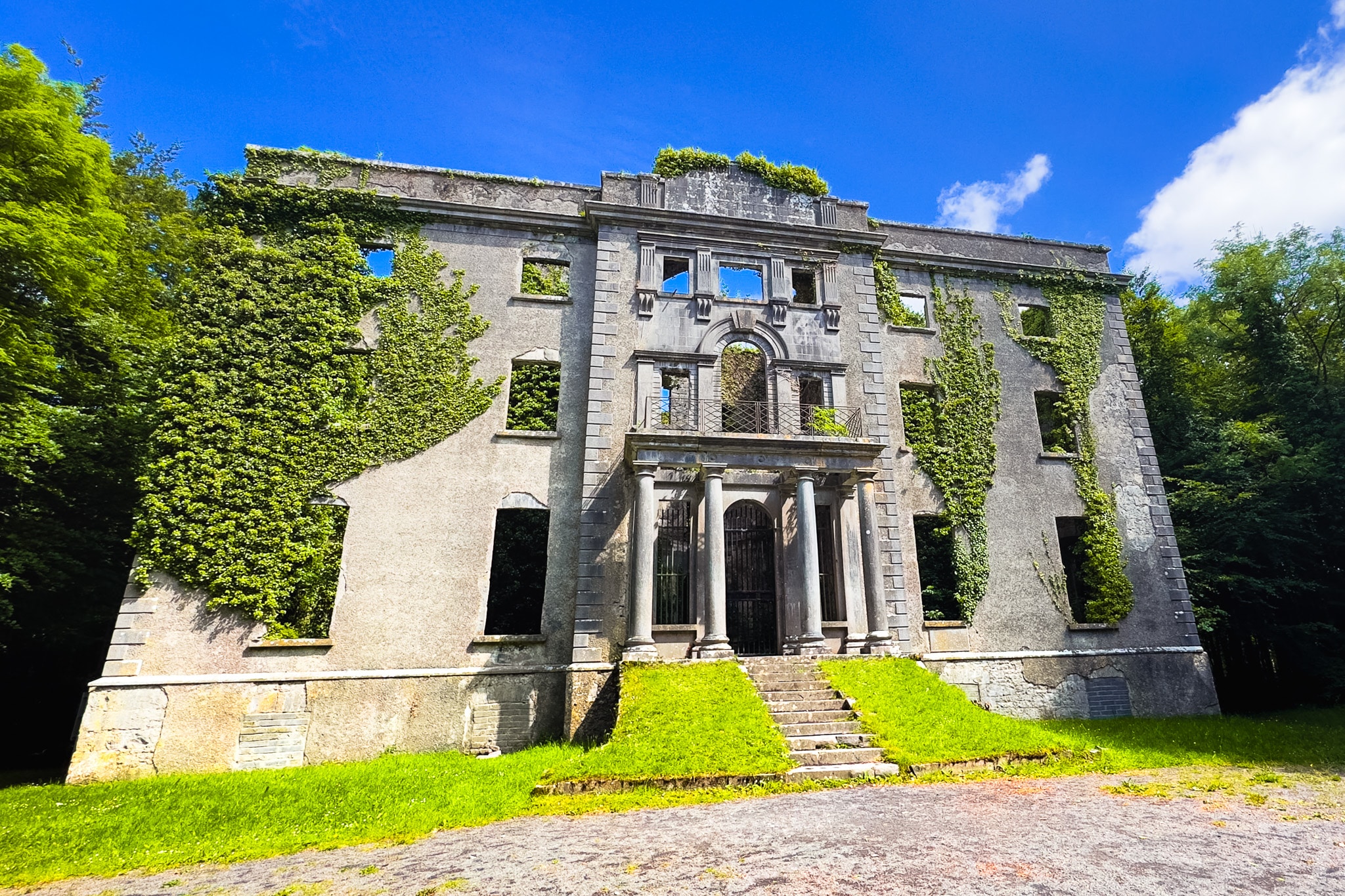
Moore Hall was a cool hidden gem we found in Ireland. It’s located in the woods of County Mayo and the abandoned mansion has been sitting in ruins for more than 100 years; apparently, the land is cursed. What could go wrong?
The story goes that George Moore, a wealthy wine and brandy merchant, built Moore Hall in the late 1700s despite local warnings about a curse connected to the land. Shortly after moving in, George suffered a stroke and eventually lost his sight. More tragedies followed the Moore family over the years, and in 1923, the house was burned during the Irish Civil War.
Today, the mansion is basically a shell. You can’t go inside, but you can walk around the huge stone exterior and explore the surrounding woodland trails.
Then there are the ghost stories. People have reported hearing laughter around the ruins and seeing figures in the trees, and paranormal investigators have apparently had their own unexplained experiences here.
Did we see anything spooky? Sadly, no. Did we even get slightly creepy vibes? Also no. We had a blast wandering around the ruins, and with all the greenery taking over the old stone walls, it felt more like a secret garden than a haunted mansion. There are even little wooden animal carvings hidden along the trails.
But then again, we didn’t go at night…
2. Powerscourt Waterfall at Powerscourt Estate
Powerscourt Estate itself is hardly a hidden gem. It’s one of the best-known places to visit in County Wicklow, with its huge gardens and grand estate house. But a short drive from the main property is Powerscourt Waterfall, and I’m surprised more people don’t make the trip over.
At 121 metres high, it’s often called the tallest waterfall in Ireland, although that title is actually debated. Either way, it’s huge, and you can get surprisingly close to the bottom of it.
You don’t need to tackle a big hike to see it, either (although there are longer options). The waterfall is an easy walk from the parking area, so it’s a simple stop to add to an Ireland road trip through County Wicklow.
It might not be completely “hidden,” but compared to some of Ireland’s better-known natural attractions, Powerscourt Waterfall feels overlooked. If you’re looking for hidden gems in Ireland that don’t require hours of hiking to reach, this waterfall is a great one to add to your route.
3. Grianan of Aileach in County Donegal
Grianan of Aileach is exactly the kind of hidden gem I love finding on a road trip. We were driving through County Donegal, spotted a sign for an ancient fort, and basically thought, sure, why not? Turns out that was a great decision.
The huge circular stone fort is 244 metres above sea level, with 360° views across Donegal and into Derry and Tyrone. You can walk around the fort and climb up onto the stone walls for an even better view. When we visited, there were barely any other people around which was awesome.
Grianan of Aileach also has a pretty interesting history. Irish mythology connects it to the Tuatha Dé Danann, with a legend that the Dagda built a fort here as a burial monument for his son. The site we see today is generally associated with the early medieval period and later became an important royal centre of the Northern Uí Néill.
It’s free to visit and an easy stop if you’re road-tripping through Donegal. Of all the hidden spots we found in Ireland by simply pulling over to see what was there, this was easily one of the best.
4. Corcomroe Abbey in the Burren
Corcomroe Abbey was another accidental find. We were driving through the Burren and spotted it on Google Maps, which obviously meant we had to stop and check it out.
The abbey dates back to the 13th century and is surprisingly well preserved. You can walk right through the ruins, see some of the original stone carvings, and find the tomb of Conor O’Brien, a former King of Thomond, who was buried here in the 1200s.
When we visited, there was barely anyone else around, so we had plenty of time to wander through on our own, which is exactly what I love about a hidden gem.
Corcomroe Abbey is free to visit and doesn’t take long to see, so it’s an easy stop if you’re road-tripping through the Burren. And if you need another reason to take a detour, Hazel Mountain Chocolate is nearby. We stopped there too, because obviously.
5. Kilcrea Castle & Kilcrea Friary in County Cork
If abandoned castles are what you’re hoping to find on an your Irish road trip, add Kilcrea to your itinerary! You actually get two historic ruins here, with Kilcrea Castle and Kilcrea Friary sitting just a short walk from each other in the countryside outside Cork.
Both date back to the 15th century and are connected to Cormac Láidir MacCarthy, who founded the friary and had the nearby castle built. It’s really cool because you’re pretty much left to explore on your own.
We had planned to climb up inside Kilcrea Castle, but there was one small problem: there were literally horses standing inside the entrance who didn’t want to move. 😂 We decided they had claimed the castle for the day and stayed outside.
The friary was much easier to explore (it’s also huge). You can wander through the old church, cloister, tower, and graveyard, and when we visited, it was incredibly quiet.
If you’re looking for hidden gems in County Cork, visit both while you’re here. They’re close enough together that you can easily see them in the same stop, assuming the local horses cooperate.
6. Gaulstown Dolmen in County Waterford
We’d already visited the much more famous Poulnabrone Dolmen in the Burren, so when we found out there was another 5,000-ish-year-old dolmen hiding in the woods in County Waterford, obviously we had to go find it.
Gaulstown feels completely different. It’s basically just sitting in the trees and you can walk right up to it, and even duck underneath the enormous capstone. It looks like people have left offerings and such inside, which is cool to see such a historic spot still being used today for more than just tourism.
We had the place to ourselves when we visited. It’s a quick stop and completely free to visit, and it ended up being one of the coolest hidden gems we found in Ireland.
7. Guillamene Swimming Cove in County Waterford
Ireland probably isn’t the first place that comes to mind when you think about going for a swim. But if that’s what you’re thinking, you obviously haven’t heard about the Irish love of sea swimming!
Guillamene Swimming Cove is just outside Tramore in County Waterford, and it ended up being one of the coolest swimming spots we found along the coast. It’s a great alternative to the famous Forty Foot in Dublin, especially if your Ireland road trip isn’t taking you anywhere near the city (or you don’t want to battle the crowds and awful parking situation).
There’s not really a beach here. You climb down the rocks and get straight into the water using the ladders, which definitely makes that first dip a little more intimidating. The water was incredibly clear, though, and I couldn’t resist getting in.
Guillamene has been a local swimming spot for generations, and you can still see the old “MEN ONLY” sign from when the cove was reserved for male swimmers. Thankfully, that rule is very much a thing of the past.
If you’re looking for hidden spots in Ireland that feel local, Guillamene is a fun spot to add to your itinerary. Just check the conditions before getting in. You’re swimming directly in the Atlantic here, and the sea can get rough.
8. Mussenden Temple & Downhill Demesne in Northern Ireland
We first spotted Mussenden Temple from the beach below and thought, “Oh, we can probably just walk along the beach to it.” You cannot.
Mussenden Temple is actually part of Downhill Demesne, a huge 18th-century estate sitting above the coast in County Londonderry. Once we figured out how to actually get up there, we realized there was a lot more to explore than the round temple we’d seen from below.
The temple itself sits right on the edge of the cliffs overlooking Downhill Strand. It was built in the 1700s as a library and was inspired by the Temple of Vesta in Italy. You can walk right up to it and look down at the beach, which is freaky because it seems like the temple is going to tumble any day now.
But don’t just see the temple and leave! Downhill Demesne is also home to the ruins of Downhill House, and you can wander around the old estate grounds before walking out toward the cliffs and Mussenden Temple.
It’s much less famous than nearby Giant’s Causeway, but that’s exactly why I’d add it to a Northern Ireland road trip. You get the ruins, the cool clifftop temple, and some incredible views along the coast, all in the same stop.
10. Fourknocks Passage Tomb in County Meath
If Newgrange is on your Ireland itinerary, Fourknocks Passage Tomb is a really cool, free alternative that hardly anyone seems to know about. Fourknocks is more than 4,000 years old and you can let yourself inside the tomb. The only catch is that you need a key.
We arrived at the same time as another group who had already picked up the key, so we got lucky and they opened it for us. Otherwise, you need to collect it from a nearby home before your visit (with a cash deposit), which is probably the most unusual admission system we came across in Ireland.
The chamber inside is surprisingly large, and keep an eye on the stones while you’re in there because there are ancient carvings throughout the tomb. Being able to walk around inside and look at them up close made Fourknocks feel completely different from some of the more heavily managed ancient sites we visited.
It’s free, quiet, and a little bit weird to access, which makes it a pretty great final hidden gem for this list.
10. Coumeenoole Beach on Slea Head Drive
I wasn’t expecting to find water this colour in Ireland! Coumeenoole Beach is tucked along Slea Head Drive on the Dingle Peninsula, and the bright turquoise water looks like it belongs somewhere much warmer than the west coast of Ireland.
The beach itself is surrounded by cliffs, with the Blasket Islands just offshore, and it’s an easy stop while driving Slea Head. It’s not exactly a secret, especially during the busier summer months, but compared to Ireland’s major attractions, it still feels like a pretty special little spot.
And yes, we went “swimming”. The water was definitely chilly getting in, but once we were in, it really wasn’t that bad. We didn’t venture very far from shore, though, and mostly just dipped our toes in. The waves can be strong here and there are dangerous currents, so this isn’t somewhere I’d recommend swimming.
Even if you have absolutely no intention of getting in the water, make time to walk down to the beach. Coumeenoole ended up being one of my favourite stops on the entire Dingle Peninsula.
Finding Your Own Hidden Gems in Ireland
After two road trips around Ireland, some of the places we still talk about most are the random stops we almost didn’t visit.
My favourite way to find them is super simple: while we’re driving, I open Google Maps, follow the road we’re already on, and zoom WAY in to see what pops up nearby. That’s how I find a lot of the random ruins, viewpoints, beaches, and historic sites that I probably never would have known to search for in the first place.
So leave a little extra time in your Ireland road trip for the places you didn’t plan. If something interesting pops up on the map or you spot a sign along the road, go see what it is. Some stops will be a bust, but others might end up being your favourite!
Have fun!